Trail Shoes vs Road Shoes: The Differences That Matter
Trail shoes and road shoes are often sold as though one were a more serious version of the other. They are not a hierarchy; they are two designs for different surfaces. A road shoe is built for smooth, predictable ground and rewards efficiency on it. A trail shoe is built for uneven, loose or rocky ground and rewards grip and protection on it, at some cost on the road.
Choosing between them is therefore not about how experienced a runner you are but about where you actually put your feet. This article sets out the differences that change the way a shoe behaves and shows how to match the shoe to the route.
The two designs serve different ground
A road shoe assumes the surface under it is flat and consistent. Its job is to cushion the repeated impact of running on hard paving and to keep the foot moving in a straight line with as little wasted effort as possible. It can be light, because it does not have to survive rocks or mud.
A trail shoe assumes the surface is neither flat nor predictable. Its job is to find grip on loose or wet ground, to protect the sole of the foot from sharp stones, to resist abrasion from grit and branches, and to hold the foot when the ground twists underneath it. It is usually heavier and stiffer as a result, and that weight and stiffness are noticeable on tarmac.
Outsole lugs and rubber
The most obvious difference is the outsole, and it is the one that matters most on loose ground.
Road shoe outsoles are mostly flat, with shallow, close-set patterns or none at all. This maximises contact with the road, which is what gives grip on a hard, dry surface. Deep lugs on tarmac actually reduce contact and can feel vague or unstable, and they wear down quickly because there is less rubber touching the ground at any moment.
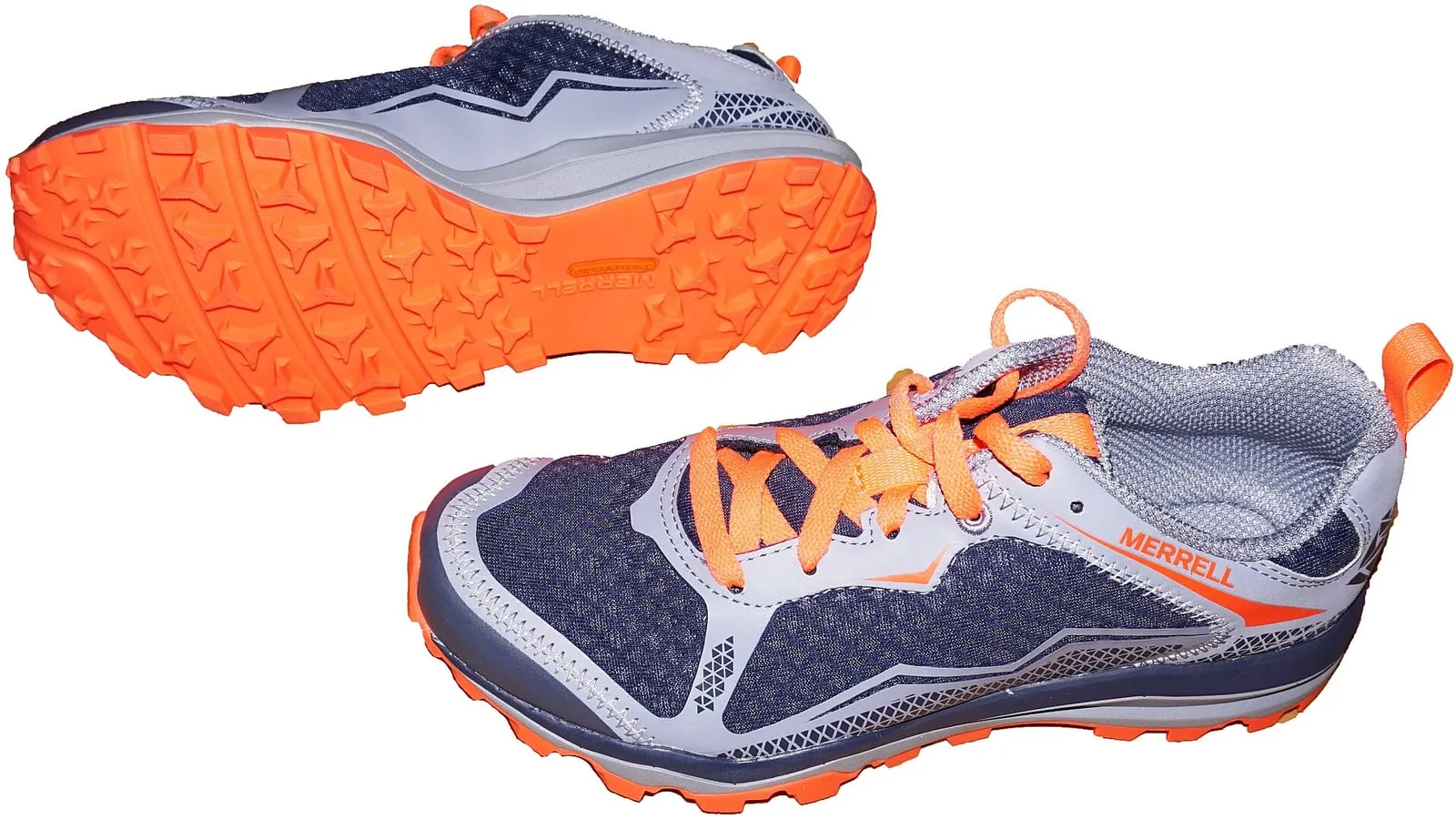
Trail outsoles use lugs: raised blocks of rubber separated by channels. Deep, widely spaced lugs bite into soft mud and loose gravel and clear themselves as you run; shallow, closely spaced lugs work better on hard-packed trails and rock, where deep lugs would feel unstable. Many trail shoes compromise between the two, which is why the trail category spans from firm, fast shoes for groomed paths to aggressive shoes for wet fell and mud.
Rubber compound matters as much as pattern. Softer, stickier rubber grips better on wet rock but wears faster on abrasive ground. Harder rubber lasts longer but slips sooner. A very sticky shoe is a reasonable choice for wet rock and a poor one for long dry miles.
Cushioning and ground feel
Cushioning is a trade-off between comfort and information. A thick, soft midsole absorbs impact and protects the foot on long runs over hard or rocky ground. A thinner, firmer midsole lets you feel the surface, which helps you place your foot precisely on technical terrain.
Road shoes tend to sit at the cushioned end, because the ground is uniform and the main problem is repeated impact. Trail shoes vary more: some are heavily cushioned for long, runnable trails, and others are deliberately firm for rocky ground where the runner wants to feel and adjust to each foothold.
Neither choice is more advanced. The question is whether you need the shoe to absorb the ground or to report on it.
Uppers and protection
Trail shoes usually have uppers designed to survive abuse. You often see a reinforced toe bumper, which protects the toes from stones and roots; a rand or a wrap of harder material around the lower edge, which resists scuffing against rock; and denser, more tightly woven or coated fabric that sheds grit and water better than a road shoe’s open mesh.
That protection has a cost. Heavier uppers hold more water and dry more slowly, and they breathe less. Road shoes favour light, open mesh that lets heat and moisture out and is quick to dry, which is the right priority on pavement, where there is little to scuff against.
Stack height, drop and stability
Three terms are worth knowing, because they appear on every product page.
Stack height is the thickness of the shoe under the foot, from the ground to the footbed. More stack means more cushioning and more distance between you and the ground, which some runners find stable and others find vague on uneven terrain.
Drop, or offset, is the difference in stack height between the heel and the forefoot. A shoe with a larger drop tilts the body forward less and suits a heel-striking gait; a shoe with a smaller drop or none encourages a flatter, more midfoot or forefoot landing and places more load on the calf and ankle. Changing drop is a change of load, and it is worth making gradually.
Stability refers to features that resist the foot rolling inward or outward, such as a firmer section of midsole or a shaped heel. On trails, a firm heel and a wide base often do the work that dedicated stability features do on the road, which is why trail shoes are frequently quite stable by design.
The cost of a waterproof membrane
Waterproof trail shoes contain a membrane that blocks water from outside. On wet grass and shallow puddles this is genuinely useful. The trade-off is that a membrane also blocks the shoe from breathing, so heat and sweat stay inside, and, once water gets in over the top or through the collar, a waterproof shoe takes far longer to dry than an unprotected one.
For very wet, cold conditions a membrane can be the right choice. For warm weather, or for runs where you will get wet anyway, a fast-draining, quick-drying shoe is often more comfortable overall.
Choosing by route, not by label
The practical method is to describe your usual routes and pick the shoe for the ground they contain.
- Mostly pavement, park paths and cycle track: a road shoe, whatever you call the running.
- Smooth, hard-packed trails and gravel: a road shoe or a lightly lugged trail shoe, which covers both.
- Mixed routes with mud, loose stones and roots: a trail shoe with moderate lugs.
- Steep, wet, soft ground: a trail shoe with deep lugs and sticky rubber.
- Long days on rocky ground with heavy loads: more cushioning and a firmer, more protective sole.
If your running is mostly on the road with the occasional trail, a road shoe will serve you on both, and a heavily lugged trail shoe will feel clumsy on the pavement. If it is the reverse, a trail shoe will keep you upright where a road shoe would slip.
Where the categories overlap
The line between the two has blurred. Many road shoes now use slightly deeper outsole patterns and reinforced uppers, and many trail shoes are light enough for road use. Some manufacturers sell hybrid shoes intended for both, and for a runner whose routes are genuinely mixed, a hybrid can be the sensible single purchase.
What matters is not the label on the box but whether the shoe’s grip, cushioning and protection match the ground you run on most of the time. A shoe that suits your route will feel right from the first mile; a shoe chosen for its category will not.