Width and Volume: What a Single Size Number Hides
A shoe marked with your size can still pinch. The number on the box describes length and little else. It says nothing about how much room your foot needs across the ball, nor how high your instep sits, nor how much space the upper leaves above your toes. Two people who both take a UK 9 can therefore have completely different experiences of the same pair, and neither of them is wrong about their own foot.
This article deals with the two dimensions a size number hides: width, the distance across the widest part of your foot, and volume, the three-dimensional space your foot occupies inside the shoe. Telling them apart matters, because the remedy for a width problem is a wider last, while the remedy for a volume problem is often a different shape altogether. Buying a longer shoe addresses neither.
What the letter after the number means
Men’s shoes in the British and American traditions are often sold with a width letter. The scale runs from narrow to wide through a sequence of letters and repeated letters: A, B, C, D, E, EE, EEE and so on, with D usually taken as the standard men’s width and B or C in women’s sizing. Each step is an increment in the girth of the shoe at the ball, not a fixed number of millimetres of visible width.
The important consequence is that width grades are relative to length. A size 6 wide and a size 12 wide are not the same width in absolute terms; they are the same proportion of girth on a different length. Manufacturers also disagree about what the baseline letter means, so a D from one maker can feel closer to an E from another.
Most casual footwear, and the great majority of trainers, is sold in a single width. The letter is simply absent, and the shoe is built on a last of average girth for its length.
Volume is a separate problem
Width is measured across the foot at the ball. Volume is the total capacity of the shoe: the height of the instep, the depth of the toe box, the space above and around the foot. A shallow shoe on a high-volume foot squeezes from above, and extra width does not help, because the pressure is coming down rather than in from the sides.
The sign of a volume mismatch is a tight, hot feeling across the top of the foot that worsens through the day, with lace marks pressed into the instep. A width mismatch feels different: pressure on the outer side of the little toe and the inner side of the big toe, with the upper visibly bulging over the edge of the sole.
You can measure your instep girth with a tape measure, wrapped around the highest point of the top of the foot and back under the arch, but there is little point unless you have the shoe’s girth to compare it with, and few sellers publish one. Reading the shape of shoes that already fit you is more practical.
Signs you need a wider last
Look at the shoes you already own. Wear leaves a record, and the pattern shows where the fit was wrong.
- The upper bulges over the edge of the sole at the ball, or the sole edge is scuffed at the outside of the big toe joint.
- The little toe has worn through the lining on the inner side, or the upper carries a crease running diagonally across the toe box.
- Your toes are visibly crowded. If the second toe sits on top of the big toe, or the little toe curls inward, the toe box is too narrow or too shallow.
- The shoes were comfortable in the shop and became painful after an hour of standing. Width problems usually announce themselves late.
Foot shape matters as much as measurement. A foot that is wide at the ball but narrow at the heel needs a shoe with a wide forefoot and a snug heel, which is a shape rather than a size. Some lasts are built that way and some are not.
Toe shape changes the answer
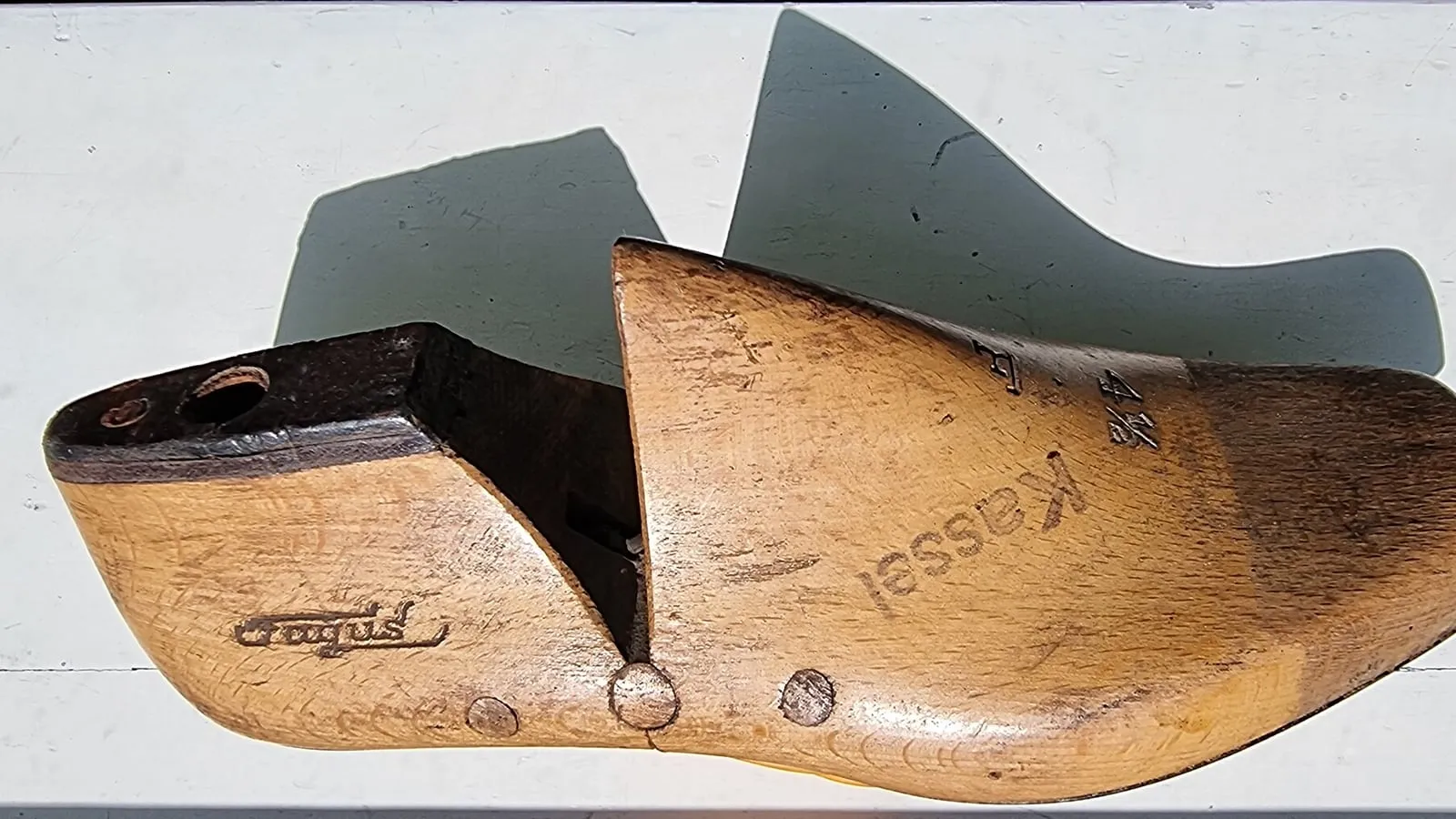
A wide last with a tapered toe can still cramp a wide foot, because the widest part of the shoe may not sit where the widest part of your foot does. Compare the line of the shoe’s sole with the line of your foot: if the shoe’s ball position sits forward or back of yours, the fit will fail even at the correct width.
The distance from your heel to the ball is worth measuring as a third number, alongside length and width. It decides where the shoe needs to flex. A shoe that bends behind or ahead of that point will fight your foot with every step, and no width grade will correct it.
Reading the last through the shoe
Two shoes of the same length and the same width letter can still feel different, because the last they were built on differs in other ways. A last with a rounded toe gives more usable space than a pointed one of the same length. A last with a high, close instep suits a slim foot and punishes a full one. A last with a narrow heel holds a slim heel in place; a last with a straight inner line suits a foot whose big toe joint sits well inboard.
None of this is printed on the box. It is learned by comparing shoes you have worn and noting which ones worked, in the same way you might note the cut of a shirt that fits. A short written record, kept on a phone, does more for your next purchase than any conversion chart.
What to do when you buy
Ask for internal measurements where they exist. Some makers publish the last width in millimetres, which is far more useful than a letter. Try the wide version of the same model rather than a longer version of the narrow one: an extra length moves the ball of the shoe forward and often makes the pinch worse, while adding width at the same length keeps the flex point aligned.
If the shoe is leather, a small amount of width can be gained by wearing it, because leather stretches where it is stressed and moulds to the foot. Synthetic uppers stretch very little, and knit uppers stretch mostly in one direction. Do not count on either to solve a genuine width shortfall.
Do not accept the advice that a shoe should feel tight and will “give”. Leather gives a few millimetres where it is pushed. It does not give a width grade.
When a wider shoe is the wrong answer
Not every tightness is a width problem. A shoe that slips at the heel while pinching at the ball is the wrong shape, not the wrong size. A shoe that is loose everywhere but tight across the instep is a volume mismatch, and the fix is a deeper or differently shaped upper. A foot that has recently changed shape or become painful is a reason to have it examined rather than to keep buying wider shoes.
A single size number is a starting point. Width and volume are the next two things to check, and they are the two things the number never told you.