Buying Shoes Online Without the Returns Cycle
Buying shoes online has one real disadvantage: you cannot walk in them before you pay. Everything else, the price, the range, the convenience, favours ordering remotely. The returns cycle that many people fall into is not an inevitable cost of shopping online; it is usually the result of missing a few details that are available before you order.
This article covers what to look for on a product page, what to ask a seller, how to use a shoe you already own as a reference, and the checks to make in the first few minutes after a parcel arrives. Done in that order, most online purchases settle on the first attempt.
What to look for on the page
Most product pages contain enough information to make a good decision, though it is often buried under styling copy and photographs. Look for these details, and note their absence as a warning.
- Internal length, in millimetres. This is the single most useful number. It describes the space inside the shoe and can be compared directly with the length of your foot plus the allowance you want at the toe.
- Last width, or width options. Some makers publish the last width in millimetres or offer several width grades. A page that offers a single width for a shoe that clearly varies is telling you something.
- Removable insole. A removable footbed lets you replace it with your own insole or remove it to gain a little depth, which helps with high-volume feet.
- Upper material. Leather and textile behave differently over time. A leather upper relaxes slightly; a synthetic or knit upper does not stretch in length.
- Weight, where relevant. For running and walking shoes, weight hints at how much cushioning and structure the shoe carries.
- Returns terms. Read them before the size chart. A generous returns window converts a sizing risk into a free trial.
Photographs help, but they flatter. Look for images that show the shoe from behind, which reveals heel width and the shape of the base, and from directly above, which shows the outline of the toe box.
Questions worth asking a seller
If the page is thin on detail, a quick message often closes the gap, and a seller who answers clearly is easier to buy from.
Ask for the internal length in millimetres if it is not listed. Ask how the model compares with the previous version of the same shoe, if there was one, since makers sometimes change the last between generations without changing the name. Ask about the width and whether the model runs narrow or generous for its size. Ask what the returns process actually involves, including who pays postage.
Measuring against a shoe you already own
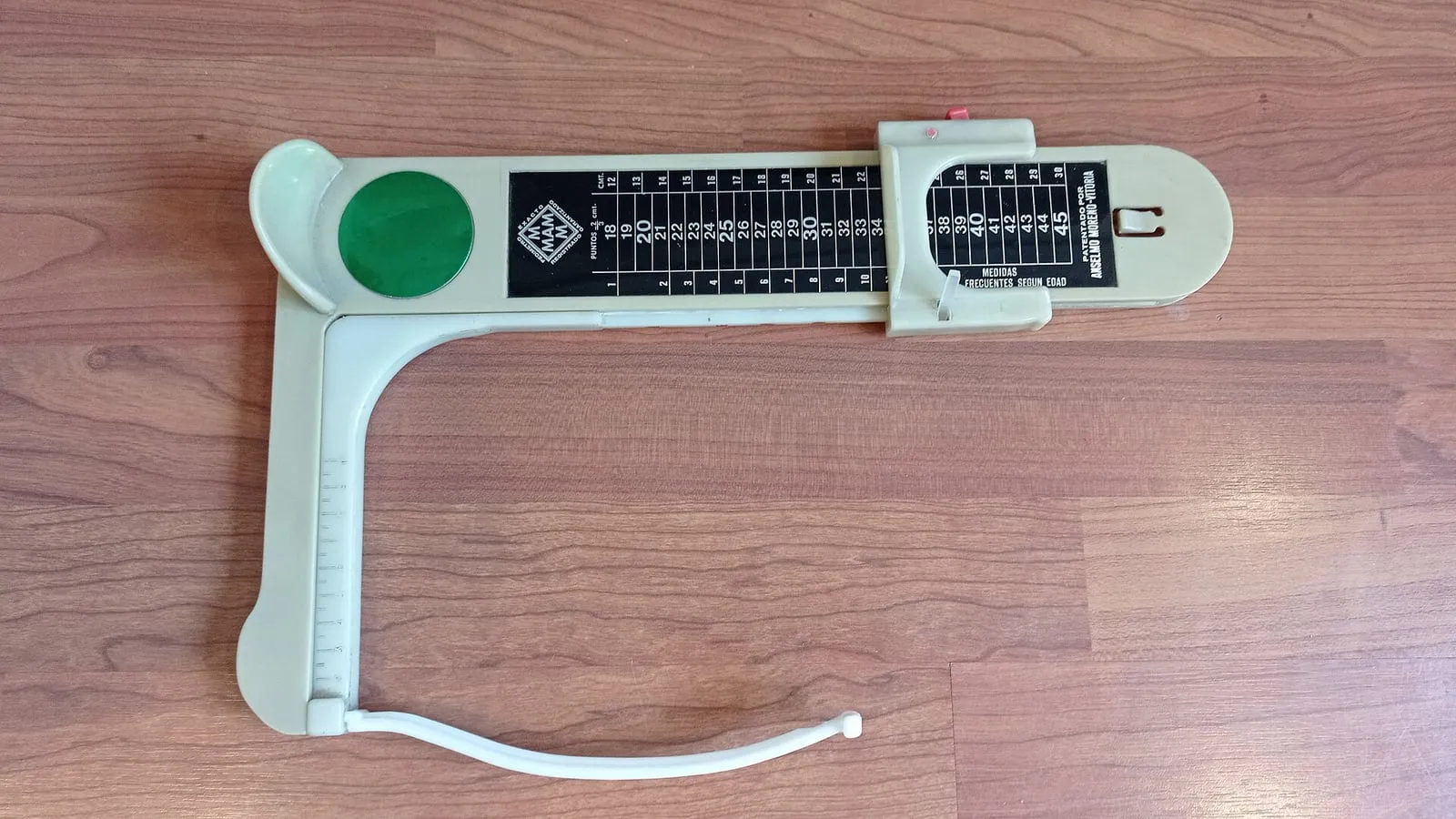
The most reliable method is to stop thinking in sizes and start thinking in measurements. Take a pair you already own that fits well and measure the removable insole, or the internal length, from heel to toe. That is the internal length you want to match.
Then measure your own foot, ideally in the evening, standing up, with the socks you intend to wear. The difference between your foot length and the shoe’s internal length is the allowance. You want roughly a thumb’s width of it at the toe, which is enough for the foot to move forward without sliding.
Compare width as well as length. Trace the outline of the insole onto paper and stand on the paper; if your foot prints wider than the insole at the ball, the shoe is too narrow before you have even ordered it. This is a crude test, but it rules out obvious mismatches.
Ordering two sizes, and its cost
If a shoe is unfamiliar and you are between sizes, ordering two sizes at once is a reasonable tactic, provided the returns terms are good. You then compare them side by side on your own floor at your own pace, which is a better test than a shop, where time pressure and carpet both distort the judgement.
The cost is the return postage and the waiting. Treat that as the price of solving a brand’s sizing once: after you know how that maker’s last fits you, you rarely need to do this again. Keep a note of what you ordered, what fit and what you returned, so that the experiment produces a lasting answer rather than being repeated next season.
If returns are expensive or impossible, the tactic stops making sense. In that case, buy from a local shop, or choose a model whose internal measurements you can match with confidence.
The first ten minutes after delivery
Do not wear the shoes outdoors until you have run through these checks, because outdoors wears them and can forfeit a return.
- Check the insole length against the shoe you measured, and against your foot plus allowance.
- Put both shoes on with the socks you will wear, lace them properly and stand up.
- Feel the toe: a thumb’s width in front of the longest toe, and toes that spread freely.
- Walk on a hard floor at home, not carpet, for several minutes. Carpet hides a firm sole.
- Check the heel: it should stay seated as you walk, with no more than a slight lift.
- Check the instep and the sides: no hot spots, and the two sides of the upper closing without a wide V.
If any of these fail, decide straight away whether to return or exchange, and keep the packaging intact until you are sure.
Timing matters as much as the checks themselves. Feet are largest in the evening, so a shoe tried on in the morning may seem roomier than it will after a day of standing. Try it at the hour when you will most often wear it, and repeat the check on a second day before you decide, because a pair that fits at nine in the morning can feel tight by six in the evening.
Document and decide
Take a photograph of the shoes and the packaging on arrival, in case a return or a dispute needs evidence. Keep the receipt and the returns details together. If you do decide to return, do it promptly, while the shoes are unworn outdoors and the packaging is undamaged.
Then record the outcome: the maker, the model, the size, the internal length if you measured it, and whether it fitted. After a few purchases you will have a personal record that is worth more than any published size chart, because it is built from your own feet and your own preferences.
Online shoe buying is unreliable only when it is treated as a lottery. Treated as a measurement exercise with a documented result, it is usually more precise than a hurried try-on in a shop with a queue behind you.